Wednesday, 19 July 2017

Sustainable Technologies: Rainwater Harvesting

https://www.sustainable.com.au/rainwater-harvesting.html

What is rainwater harvesting and why is it Important?

Water is our most precious natural resource and something that most of us take for granted. We are now increasingly becoming aware of the importance of water to our survival and its limited supply, especially in such a dry continent as Australia.
The harvesting of rainwater simply involves the collection of water from surfaces on which rain falls, and subsequently storing this water for later use. Normally water is collected from the roofs of buildings and stored in rainwater tanks. This is very common in rural Australia. Water can also be collected in dams from rain falling on the ground and producing runoff.
Either way, the water collected can be considered to be precious.

Rainwater harvesting techniques

The collection of rainwater from the roofs of buildings can easily take place within our cities and towns, not just in rural Australia. All that is necessary to capture this water is to direct the flow of rainwater from roof gutters to a rainwater storage tank. By doing this, water can be collected and used for various uses.
If you are reliant on collected rainwater and are not connected to a towns water supply, then the water collected will be especially important to you. If you are from the city, then it is possible to replace all or at least a substantial portion of your fresh water requirements by the capture and storage of rainwater from your roof. Being largely self sufficient in water supply is possible for a vast majority of Australian households and buildings.

What are the Benefits in Rainwater Harvesting?

By capturing water directly, we can significantly reduce our reliance on water storage dams. This places less stress on these dams and can potentially reduce the need to expand these dams or build new ones.
Collecting and using your own water can also significantly reduce your water bills.
By capturing water, the flow of stormwater is also reduced and this minimises the likelihood of overloading the stormwater systems in our neighbourhoods.

What About Dirty Roofs?

There are a number of devices (first flush devices) which allow for the first flow of water to the rainwater storage tank to be diverted from the tank. By doing this, any dirt on the roofs of buildings that has built up prior to the rain can be excluded from the tank.

Sizing of Rainwater Storage Tanks

The most appropriately sized rainwater storage can be chosen by quantitatively assessing the performance of various sized storage capacities. By assessing the performance of various sized storage capacities, it is possible to make an informed decision as to what would be the most suitably sized storage capacity for the given application. The input for the assessment is historical daily rainfall data, and the performance of a particular storage capacity can be judged by how much water is required to be supplied from other sources to makeup for any shortfall in demand.

Water Balance for Estimation of Rainwater Storage Capacity

The size of the area of capture or roof area must also be known when estimating the amount of rainfall that is able to be collected. The larger the roof area, the more rainfall that is able to be collected.

Assessing Performance of Different Sized Rainwater Storage Tanks

The performance assessment of various sized storages involves the calculation of the amount of water in storage for a given day. This calculation is based on the water balance shown above. This is a simple calculation, however, using a computer allows this calculation to be completed for many consecutive days of rainfall data. This is equivalent to trial sizing a storage tank size over the period of assessment (over many years).
The computer model completes daily water balance calculations, so that any roof runoff generated from rainfall in that day is calculated. The computer model also calculates the daily level status of the water storage used to hold this rainwater.
During any one day the storage could overflow depending on the amount of roof runoff generated. Likewise, the storage could also be emptied if the volume of water used exceeds the amount of water available from the storage. In this case, water must be supplied from other sources in order to fulfil the water demand. The computer model calculates and sums the amount of water supplied from other sources over the period of assessment. This information can then be used for a comparative assessment of the different amounts of makeup needed with use of different size water storages.

Capturing Ground Runoff

The concepts of rainwater harvesting are not only applied to roof catchments. Ground runoff can be modelled and used as input to overall water balance calculations. Additionally, the size and nature of water usage can be modelled. The computer model can also account for the way the water is handled. All of these factors can be incorporated into an overall water balance model so that the best strategy for capturing and managing this most precious of natural resources can be determined.

Sustainabale Technologies: Sustainable Architecture and Construction

https://www.sustainable.com.au/sustainable-architecture.html
https://www.sustainable.com.au/energy-efficient-construction.html

Sustainable design or ecological design (also referred to as green design, or sustainable architecture) is a philosophy of designing buildings to comply with the principles of social, economic and ecological sustainability.
There are many stages to effective sustainable architectural design. Green building design involves a number of stages:

Sketch Design

This stage is also known as concept design. It involves the inspection of the site to assess the conditions and constraints as well as meetings for briefing purposes to establish the master planning or long term objectives for the site, detailed accommodation requirements, and discussion of design aesthetics before you get started with any type of conceptual design. This is usually something you would do with an your building planner or architectural team.
Preliminary analysis of authority regulations and requirements should also be undertaken during this stage - if necessary, you should also meet with the authorities as required to discuss your project requirements. The next stage is normally then to prepare sketch design drawings including concept sketches, diagrams and other information to explain the proposed design solution. This stage normally includes preliminary selections of materials and finishes.

Detailed Design

Once you are happy with your "sketch design" - further design details need to be considered, including the resolution of the constructional systems, materials and finishes in accordance with the project budget and site constraints - you would do this in collaboration with your building's designer until you are both happy with the both the design and budget.
At this stage you should usually be able visualise you sustainable building using a computer generated 3D model which will even include "fly-throughs" so that you can fully grasp the design proposal.
After further discussion and prototyping (it's usual that you might have additional requirements of second thoughts about various design elements). Your architect will then develop the approved sketch design into a final design solution and prepare the requisite drawings and schedules listing materials and finishes to explain the scheme.
During this stage, your sustainable building designers/planner will also co-ordinate the design work being undertaken by the other consultants to ensure that they comply with the architectural intent of the scheme. If you intend to project manage all or part of your building project, then you may be responsible in part for managing this process, a well as performing your own due diligence on building materials, suppliers and other contractors who may become involved in your project.
At this stage you will generally also start preparing the necessary documents for any planning applications that may be required by the authorities and assist you with lodging the application. If you are in building NSW then you should be aware of BASIX assessments which applyl residential developments throughout NSW with a total estimated cost of works of $50,000 or more.

Contract Documentation

This stage involves the preparation of drawings including plans, elevation and sections, together with other details and schedules to enable the project to be approved by the authorities, tendered and constructed. During this stage you will also need to co-ordinate and integrate the work of the other consultants to ensure the success of the project. Once all documentation has been completed you will need to lodge documents for building approval and then call tenders for the works.

Contract Administration

This stage involves the organisation of the tender process so that you can obtain a number of competitive prices from reputable builders before choosing which builder you would like to engage for the construction of the works. After closing the tenders you should then analyse and assess the submissions with your building planners and your architect.
Once you have selected the builder you would like to engage, your planners would typically prepare a three-party contract that is approved by the Royal Australian Institute of Architects and the Master Builders Association for signing by all parties.
This contract will generally allow a sustainable building planner to act as your representative in all negotiations concerning construction quality and monetary payments, thereby offering you a degree of protection in an area that you may not be familiar with.
During construction - unless agreed otherwise - your planner will also undertake periodic site inspections, check work in progress regarding design quality control, materials selections and performance requirements as described in the contract documents.
A good sustainable building planner will also review shop drawings and other builder's submissions and provide extra details, information and instructions as required to ensure the success of the project.
Alongside your planner, you should also arrange to attend site meetings, administer variations to the contract if required. It's also important that you review and assess claims from the builder and issue progress certificates accordingly. If necessary, your planner will also help you assess and dis/approve claims for extension of time co-ordinate the other consultants, prepare defects lists prior to practical completion and assess rectification work before processing the final contract account.
Energy efficient construction
There are a range of sustainable building materials that are both Earth friendly and elegant at the same time. Mud brick and poured Earth construction techniques are just a few of the options available for earth friendly construction. Building with alternative materials can be a challenging but ultimately rewarding adventure.
Below you'll find some some tips, advice and information to consider if you're thinking about embarking on a energy efficient building project that involves sustainable building materials.

Earth Building

Mudbrick, also referred to by the Spanish name of 'Adobe' which means mud or puddled earth, generally refers to the technique of building with sun-dried mud blocks in either load bearing or non load bearing construction. Mudbricks are becoming increasingly commercially available in a range of stabilised and non stabilised bricks.
Mudbrick has several advantages over conventional fired clay or concrete masonry. The advantages include:
  • Low in embodied energy
  • Utilisation of natural resources and minimal use of manufactured products
  • Good sound absorption characteristics
  • High thermal mass
  • A claimed ability to "breath"
  • Suited to a wide range of soils
  • Easily manufactured and worked
  • Flexibility in design/colour/surface finishes
  • Insulation properties similar to those of concrete or brickwork
Mudbricks are typically 250 mm wide x 125 mm high x 375 mm long and normally made from earth with a clay content of 50 to 80% with the remainder comprising a grading of sand, silt or gravel. Kaolin clays are the preferred clay types due to their non expansion characteristics. Stabilising the mudbrick with straw or other fibres is sometimes employed where the soil mix displays excessive shrinkage behaviour. Cement and bitumen stabilising is also used with the latter particularly effective in waterproofing.
From an engineering viewpoint, mudbricks typically have compressive strengths of around 1 to 2 MPa and need to posses a demonstrated resistance to erosion and cracking before being accepted for construction. Mortar for mudbrick laying is either a traditional sand/cement mortar or a fine aggregate soil mortar preferably made from the same parent material as the mudbrick units.
Finishing of mudbrick walls can be undertaken with a variety of techniques ranging from as constructed to a simple "bagged" finish to a full set earth render. Linseed oil is commonly used to seal the exterior of as constructed mudbrick.

Cast Earth (Poured Earth) Construction

Also called, rammed Earth construction, cast earth is a modified and now patented building material which uses a composite which is is made up with soil as its bulk component. Generally it is mixed with calcined gymsum (plaster) instead of cement. Generally it can be used to form solid walls without reinforcement. Forms are typically set up and then filled (or poured) with the cast earth. The forms are removed once the mix has set.

Other Earth Friendly Building Materials

Where possible sustainable buildings should be manufactured off site - this approach helps to reduce wastage and helps to maximise recycling (because it can be done on site). Building materials which might also be considered "sustainable" also include green lumber from certified growers. Recycled stone, recycled metal (and other recyclable products, including tiles, glass and even tyres) can be used.
If you're not sure where to start, or what materials might be appropriate for your building, you should discuss your requirements with a a building planner who has had experience creating ecologically friendly designs in the materials you may be considering for your project.

Tuesday, 21 March 2017

World Water Day; March 22

Leaf biodegradable Plates

https://www.kickstarter.com/projects/643319217/beleaf


It all started with a vision: Outdoor tableware, as renewable and biodegradable as a leaf falling from a tree. And here we are.
 Next time you eat outdoors, feel the nature in your hands. Enjoy the summer. And the unbeatable feeling of making the world a greener place.

What is our approach? 

We focus on food packaging and one-way dishes. Our claim: outdoor tableware has to be fully renewable and fully biodegradable. After years of designing, prototyping and testing, we’ve succeeded.

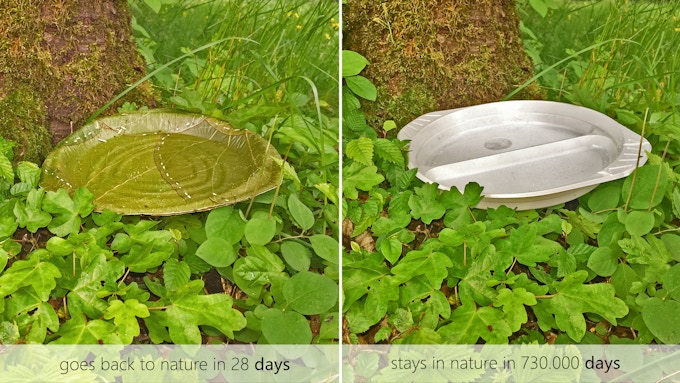
Our disposable tableware is made of nothing but leaves – leaves that regrow three times a year and degrade in every household’s compost.

What are the plates made of? 

Our plates consist of leaves. And leaves only. The bottom and top layer are made from leaves, stitched together with fibers from palm leaves. And in between, you find a layer of paper made of leaves. 


That's it. No plastics, additives, oil, glue, chemicals,... Only leaves. 


And yet, they are water-proof.

How are they made?

The whole process lies in our hands: From the first sketches to renderings, from 3D prints of prototypes to CNC-milling of the tools.


And of course every single product is manufactured and strictly controlled for quality at our production site in Germany, near Munich.


Our team consists of designers, tool makers, and engineers, all working closely together in order to shape the perfect product. For you.

How did it all start?

It all started in Pedram's head, and manifested in his living room.


There we installed our first pressing machine, completely operated manually - or more precisely, by foot.
 Then our knowledge grew, and so did our ambitions. 


We raised money, constructed our first semi-automatic prototyping machine, and presented our products in public. 


This is not only about outdoor tableware. It is about food packaging. It is about preventing plastic waste. It is about preventing trees from being cut for paper production. It is about the next generations. 

What is the money used for?

We have successfully finished development and prototyping. We erected a small scale production facility and started our production.


Now we are ready for the next steps: We will automate our production to scale it up and to bring leaf products to every shelf, to everyones hand, and to every compost. Therefore, we need a new production line and new tools. The fully automated production line will be built by a German machine manufacturer - our trusted engineering partner since long times. 


Every Cent you pledge will be put into development and into production. Together, we will create a greener world - replacing plastic food packaging with packaging made from leaves.

What's in it for you?

We know that you make pledges for a cause. Because you want to support an idea. Because you want to use your power to shape the world. And we know that there has to be something interesting in it for you as well. So here is our offer: You support us in reaching our goal of changing the world of one-way dishes and packaging. And in return, we will supply you with the greenest tableware in the word - one package a year, as long as you live.
If you are looking for plates for a special occasion like a big party or even your wedding, we also prepared a rectangular bowl, e.g. for finger food, side dishes, or sweets: Your package contains these bowls as well as plates of two sizes, printed with our wedding theme or your individual text or logo. 

The plates come in diameters of 7 inches and 8 inches, and the bowl is 9x4 inches wide.
And we are also prepared for your business needs : We offer whole pallets for businesses and resellers as well as customized bowls or plates for bulk buyers.

Our Motivation


We are lucky to have healthy, intact forest just around the corner of our office – nature as it should be.

But sadly, reality looks different.
But sadly, reality looks different

Every 2 seconds, woods of the size of a soccer field are cut down. This sums up to 13 million hectares of wood every year that are deforested for producing pulp out of them - this actually equates the size of England!
And on the other hand, we face ever growing mountains of garbage: more than 1.000.000.000 (1 billion) tons per year, equalling the size of the Mount Everest.
We are drowning in garbage of paper and plastic, and we are over-using our resources. This is actually resulting in mountains of packaging waste - and every one-way plate made of paper or plastic adds to it. The main cause: The way we package things.  We decided to try and change this.

Why are we doing this? 

Because we spend only a brief moment on this world. Everything we own is only temporary. What really counts is what we create, what we build up. What counts are our actions and our decisions. They last forever. They make up the true value of our being. If these actions lead to building up a sustainable, social, gainful company, then we will have the greatest job in the world.
Head of Department
Head of Department
Be part of it
Back us. Spread the word. Become a citizen of the leaf republic. 
And besides of making the world a better place, we offer you a unique reward: You will get your personal set of leaf plates, from now till the end of your life, delivered to you every year in spring.
Enjoy what we created: Outdoor tableware for the summer of your life.

Risks and challenges

Producing something as new and as innovative as our plates needs detailed planning and clear specifications. We did our homework and tested all elements of the process, challenged every element of our supply chain, and spent months of prototyping. Like this, we got our small scale production up and running.
Scaling up your production is always challenging and thrilling.
We took our learnings from small scale production and thoroughly planned the full-production run.
During manufacturing ramp-up, we will not take our eyes of our manufacturing facilities for one single second. And we will steadily refine the process, so that the plates will exceed all your expectations.
As experience told us, manufacturing projects tend to face challenges with timing. Thus, we made conservative estimates on delivery dates and added generous buffer. Be assured: we will keep you up-to-date about your delivery.