Tuesday, 21 March 2017

Leaf biodegradable Plates
https://www.kickstarter.com/projects/643319217/beleaf
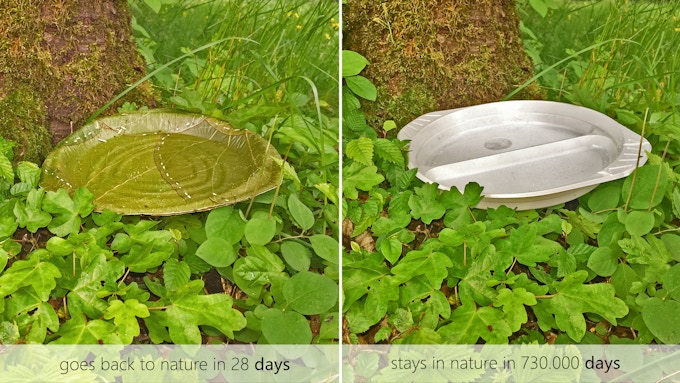


It all started with a vision: Outdoor tableware, as renewable and biodegradable as a leaf falling from a tree. And here we are.
Next time you eat outdoors, feel the nature in your hands. Enjoy the summer. And the unbeatable feeling of making the world a greener place.
What is our approach?
We focus on food packaging and one-way dishes. Our claim: outdoor tableware has to be fully renewable and fully biodegradable. After years of designing, prototyping and testing, we’ve succeeded.
Our disposable tableware is made of nothing but leaves – leaves that regrow three times a year and degrade in every household’s compost.
What are the plates made of?
Our plates consist of leaves. And leaves only. The bottom and top layer are made from leaves, stitched together with fibers from palm leaves. And in between, you find a layer of paper made of leaves.
That's it. No plastics, additives, oil, glue, chemicals,... Only leaves.
And yet, they are water-proof.
How are they made?
The whole process lies in our hands: From the first sketches to renderings, from 3D prints of prototypes to CNC-milling of the tools.
And of course every single product is manufactured and strictly controlled for quality at our production site in Germany, near Munich.
Our team consists of designers, tool makers, and engineers, all working closely together in order to shape the perfect product. For you.
How did it all start?
It all started in Pedram's head, and manifested in his living room.


There we installed our first pressing machine, completely operated manually - or more precisely, by foot.
Then our knowledge grew, and so did our ambitions.
We raised money, constructed our first semi-automatic prototyping machine, and presented our products in public.
This is not only about outdoor tableware. It is about food packaging. It is about preventing plastic waste. It is about preventing trees from being cut for paper production. It is about the next generations.
What is the money used for?
We have successfully finished development and prototyping. We erected a small scale production facility and started our production.
Now we are ready for the next steps: We will automate our production to scale it up and to bring leaf products to every shelf, to everyones hand, and to every compost. Therefore, we need a new production line and new tools. The fully automated production line will be built by a German machine manufacturer - our trusted engineering partner since long times.
Every Cent you pledge will be put into development and into production. Together, we will create a greener world - replacing plastic food packaging with packaging made from leaves.
What's in it for you?
We know that you make pledges for a cause. Because you want to support an idea. Because you want to use your power to shape the world. And we know that there has to be something interesting in it for you as well. So here is our offer: You support us in reaching our goal of changing the world of one-way dishes and packaging. And in return, we will supply you with the greenest tableware in the word - one package a year, as long as you live.
If you are looking for plates for a special occasion like a big party or even your wedding, we also prepared a rectangular bowl, e.g. for finger food, side dishes, or sweets: Your package contains these bowls as well as plates of two sizes, printed with our wedding theme or your individual text or logo.
The plates come in diameters of 7 inches and 8 inches, and the bowl is 9x4 inches wide.
And we are also prepared for your business needs : We offer whole pallets for businesses and resellers as well as customized bowls or plates for bulk buyers.
Our Motivation
We are lucky to have healthy, intact forest just around the corner of our office – nature as it should be.
But sadly, reality looks different
Every 2 seconds, woods of the size of a soccer field are cut down. This sums up to 13 million hectares of wood every year that are deforested for producing pulp out of them - this actually equates the size of England!
And on the other hand, we face ever growing mountains of garbage: more than 1.000.000.000 (1 billion) tons per year, equalling the size of the Mount Everest.
We are drowning in garbage of paper and plastic, and we are over-using our resources. This is actually resulting in mountains of packaging waste - and every one-way plate made of paper or plastic adds to it. The main cause: The way we package things. We decided to try and change this.
Why are we doing this?
Because we spend only a brief moment on this world. Everything we own is only temporary. What really counts is what we create, what we build up. What counts are our actions and our decisions. They last forever. They make up the true value of our being. If these actions lead to building up a sustainable, social, gainful company, then we will have the greatest job in the world.
Head of Department
Be part of it
Back us. Spread the word. Become a citizen of the leaf republic.
And besides of making the world a better place, we offer you a unique reward: You will get your personal set of leaf plates, from now till the end of your life, delivered to you every year in spring.
Enjoy what we created: Outdoor tableware for the summer of your life.
Risks and challenges
Producing something as new and as innovative as our plates needs detailed planning and clear specifications. We did our homework and tested all elements of the process, challenged every element of our supply chain, and spent months of prototyping. Like this, we got our small scale production up and running.
Scaling up your production is always challenging and thrilling.
We took our learnings from small scale production and thoroughly planned the full-production run.
During manufacturing ramp-up, we will not take our eyes of our manufacturing facilities for one single second. And we will steadily refine the process, so that the plates will exceed all your expectations.
We took our learnings from small scale production and thoroughly planned the full-production run.
During manufacturing ramp-up, we will not take our eyes of our manufacturing facilities for one single second. And we will steadily refine the process, so that the plates will exceed all your expectations.
As experience told us, manufacturing projects tend to face challenges with timing. Thus, we made conservative estimates on delivery dates and added generous buffer. Be assured: we will keep you up-to-date about your delivery.
Sunday, 26 February 2017
Friday, 17 February 2017
Saturday, 14 January 2017
Gadget mountain rising in Asia threatens health, environment

https://apnews.com/d5e820613c5d42c3a264df97885efa43/Gadget-mountain-rising-in-Asia-threatens-health,-environment?utm_campaign=SocialFlow&utm_source=Twitter&utm_medium=AP
By STEPHEN WRIGHT

JAKARTA, Indonesia (AP) — The waste from discarded electronic gadgets and electrical appliances has reached severe levels in East Asia, posing a growing threat to health and the environment unless safe disposal becomes the norm.
China was the biggest culprit with its electronic waste more than doubling, according to a new study by the United Nations University. But nearly every country in the region had massive increases between 2010 and 2015, including those least equipped to deal with the growing mountain of discarded smartphones, computers, TVs, air conditioners and other goods.
On average, electronic waste in the 12 countries in the study had increased by nearly two thirds in the five years, totaling 12.3 million tons in 2015 alone.
Rising incomes in Asia, burgeoning populations of young adults, rapid obsolescence of products due to technological innovation and changes in fashion, on top of illegal global trade in waste, are among factors driving the increases.
"Consumers in Asia now replace their gadgets more frequently. In addition, many products are designed for low cost production, but not necessarily repair, refurbishment or easy recycling," said the study. It urges governments to enact specific laws for management of electronic waste or rigorously enforce existing legislation.
Only South Korea, Taiwan and Japan have long established recycling systems based on laws introduced in the 1990s. Open dumping of lead- and mercury-laden components, open burning of plastics to release encased copper and unsafe backyard operations to extract precious metals are the norm in most countries including Indonesia, Thailand and Cambodia, which also lack laws governing the treatment of electronic and electrical waste.
The study said open burning and unsafe recycling is associated with a slew of health problems for workers and communities near recycling operations They include infertility, childhood development problems, impaired lung function, liver and kidney damage, inheritable genetic damage and mental health problems.
Backyard recyclers are after gold, silver, palladium and copper, mainly from printed circuit boards, but the crude acid bath extraction process releases toxic fumes and is also inefficient, recovering only a portion of the valuable material.
Asia as a whole is the biggest market for electronics and appliances, accounting for nearly half of global sales by volume, and produces the most waste.
Guiyu, a heavily-polluted rural town in China that specializes in dismantling consumer electronics, some of it exported from rich countries, has become synonymous with the costs of a throwaway high-tech world.
China has cleaned up Guiyu and other centers like it but the Basel Action Network, which brought Guiyu to international attention, said most of the dangerous practices continue in Guiyu albeit concentrated within a new industrial park on its outskirts.
Ruediger Kuehr, one of the study's authors, said the amount of waste being generated is higher than governments estimate, partly because of their narrower definitions, and should be a wake-up call to policymakers and consumers.
"We are all benefiting from the luxury of these electrical and electronic products to a certain extent, it makes our lives easier, sometimes more complicated," he said. "However if we want to continue like this we must be reusing the resources contained in electronic and electrical equipment."
A smartphone, for example, uses more than half the elements in the periodic table, some of which are very rare, and in the longer-run will be exhausted without recycling, said Kuehr.
Friday, 23 December 2016
Monday, 24 October 2016
Subscribe to:
Posts (Atom)